A wooden pizza board isn’t just about serving up your slice of heaven. Things like the grain, thickness, finish, and edge shape really influence how it feels when you’re holding it and how it performs during everyday use. For buyers around the world, paying attention to these little details actually makes a difference—besides just looking at price, lead time, packaging, and how well you communicate with your supplier. Sometimes, what seems like a tiny difference can tip the scales when deciding which one to buy.
This guide to the top wooden pizza boards for 2026 is all about helping global buyers choose smartly, based on practical criteria. We’ll cover common wood types, sizes, handle styles, surface feel, and what kind of care your board might need. And don’t forget—it's a good idea to ask for clear product specs and any relevant food-contact certifications, especially if you’re selling in specific markets. Since requirements can vary a lot, just getting a supplier’s guarantee isn’t always enough—double-check those details.
A helpful tip? Don’t just look at glossy product photos. Ask about how the boards are finished, how they handle color or grain variations, and whether the samples you see match the actual product. A board might look gorgeous but feel weird when you’re lifting a hot pizza—trust me, that stuff matters. Before placing a big order, it’s worth chatting about exact dimensions, how sturdy the construction feels, and what kind of packaging will keep it safe during shipping. It’s not going to be perfect—natural wood is naturally varied, and a sample can’t reveal every little quirk in production. Still, asking the right questions helps you make smarter choices and set realistic expectations with your supplier.

For global buyers comparing Wooden Pizza Boards, material choice affects weight, edge wear, and care. Maple and beech offer close, even grain; acacia often shows stronger color variation. USDA Forest Products Laboratory’s Wood Handbook (2021) reports typical shrinkage of about 6–12% across the grain and 3–6% radially as wood dries. Species and cutting direction matter. A board that looks flat in a showroom may move in a dry kitchen.
Round boards suit pizza serving and table presentation. A long-handled peel shape helps move uncooked dough, while rectangular boards use shelf space efficiently. Check the handle joint, thickness, and smoothness around the rim. Small surface marks are not always defects, but deep checks can trap crumbs and moisture. Not ideal for every job.
Main uses include slicing, serving, and carrying pizza from counter to table. Wood can protect knife edges better than many hard surfaces, though repeated cutting leaves marks. Avoid assuming every board belongs in an oven. Buyers should request clear care instructions and inspect samples after washing and drying. Here, details matter. One weakness in many product listings is the lack of wood-species and moisture information; that gap deserves scrutiny.
A Pizza Cutting Board should feel steady before the first slice. A broad, flat surface gives a wheel cutter room to roll without catching on raised edges. For serving, a subtle bevel helps lift slices while keeping the board’s profile clean. Deep grooves may collect toppings and crumbs, but they can also make cleanup less convenient. Small design choices matter.
Wood grain and thickness affect daily handling. A dense, well-finished surface can resist dents from repeated cutting, though no wooden board stays mark-free forever. The handle should offer enough clearance for fingers, even when the board is warm from the oven-side table. Too much length can make storage awkward. A little trade-off. In practical use, a lighter board is easier to carry, while added thickness often feels more stable under a cutter. Check that the surface has a smooth, food-safe finish and no rough seams where crumbs can lodge. After serving, wipe it promptly and let it dry upright; soaking may cause the wood to warp. That detail is easy to overlook. Some buyers may prefer a perfectly pristine surface, but visible knife marks are part of a working board, not necessarily a defect.
| Board format | Representative size | Common wood options | Design details | Effect on cutting and serving | Handling and care considerations |
|---|---|---|---|---|---|
| Round, flat paddle | 30–35 cm diameter; 1.5–2 cm thick | Beech, maple, or acacia | Circular deck with a short, integral handle; often a smooth perimeter | A broad, continuous surface suits presenting a round pizza and cutting it into wedges. A flat face provides no barrier to crumbs or juices. | The handle offers a grip for carrying, but the board’s overall diameter can make storage and one-handed lifting awkward when loaded. |
| Round board with perimeter groove | 33–40 cm diameter; 1.8–2.5 cm thick | Maple, beech, or acacia | Shallow channel routed around the usable surface, sometimes with a recessed handhold | The groove can collect some loose crumbs and liquid, while the remaining flat area supports slicing and serving. It does not replace a deep rim or tray. | Grooves need brushing or wiping during cleanup. Check that the channel does not reduce the usable cutting area too much. |
| Rectangular serving board | 35 × 25 cm to 45 × 30 cm; 1.5–2.5 cm thick | Beech, maple, or walnut | Straight edges; may include a hanging hole or shallow serving rim | The elongated shape can accommodate pizza slices, flatbreads, or shared portions. Straight edges make it easier to align alongside plates or other serving dishes. | A hanging hole can simplify storage but should be smooth and easy to clean. Wider boards require more shelf or drawer space. |
| Large round family board | 40–50 cm diameter; 2–3 cm thick | Acacia, maple, or beech | Large uninterrupted deck; optional routed edge or side grips | More surface area gives room for larger pizzas and serving accompaniments. A large deck also needs more counter space for safe cutting. | Greater diameter and thickness add weight. Side grips can help with lifting, but the loaded board should be carried with both hands. |
| Board with integrated handle | 30–38 cm deck length; 10–15 cm handle; 1.5–2.5 cm thick | Beech, maple, or acacia | Narrow extension with a rounded grip; may include a hanging hole | The handle keeps the gripping area separate from the food surface and supports carrying. The cutting area is smaller than the board’s total length suggests. | A comfortable grip and well-finished transitions reduce snagging. The handle can create a leverage point, so avoid lifting a heavily loaded board by the tip alone. |
| End-grain wood board | 30–40 cm across; commonly 3–5 cm thick | Maple or other suitable hardwoods, assembled from blocks | Block pattern exposes the ends of the wood fibers on the cutting face | The thick, heavy surface is stable for cutting and serving. End-grain construction is commonly used for cutting boards, but it does not make a surface immune to knife marks. | Often heavier and bulkier than a thin serving board. Keep it dry between uses and follow the maker’s care instructions for the wood and adhesive construction. |
| Bamboo laminated board | 30–40 cm across; approximately 1–2 cm thick | Laminated bamboo strips | Strip-built panel; may be round, rectangular, or paddle-shaped | A relatively light panel can work for serving and occasional slicing. Surface feel and knife wear vary by construction and finish. | Bamboo is a grass, not a tree wood, and laminated boards use bonded strips. Do not assume a product is dishwasher-safe; check its care instructions. |
Buyer note: Wood species, construction, finish, actual dimensions, and care requirements vary by item. Confirm usable cutting area, board weight, food-contact finish, and cleaning instructions with the supplier before ordering.
Wooden pizza boards serve different jobs, so buyers should match shape and construction to how customers will use them. A round serving board gives a pizza room to sit flat and looks natural on a dining table. It suits restaurants, homeware retailers, and gift ranges. A broad, flat design is easy to wipe, though its weight and storage space deserve a closer look.
For moving dough into an oven, buyers may prefer a peel-style board with a tapered edge and a long handle. Check that the handle feels secure and does not make the board awkward to store. It should be thick enough for regular handling, but not so bulky that staff struggle with it. Small details matter. Rounded edges can feel better in the hand, while a hanging hole may help shops display the product.
Some buyers need a compact paddle board for individual pizzas or countertop service. Others may want a larger, heavier board for sharing and presentation. Wood grain, surface smoothness, and a stable base affect both appearance and everyday use. Ask suppliers about wood species, moisture control, finish, and care instructions; these details help assess consistency between shipments. A food-contact-safe finish is worth verifying in product documentation. There is no perfect all-purpose board. A larger surface may serve guests well but take up valuable shelf space, and that trade-off is easy to underestimate.
For a Pizza Chopping Board, wood selection is only part of the quality check. Ask suppliers to identify the species and provide traceability for the timber. A dense, well-dried wood can resist deep cuts, but species alone cannot guarantee performance. Check for cracks, loose joints, rough edges, and uneven surfaces. Look closely at the handle and hanging hole, where splinters can hide. Small details count.
Food safety depends on more than a clean appearance. Confirm that any oil, wax, or other finish is suitable for food-contact use, and request supporting documentation for the destination market. Ask how the board is dried, bonded, and inspected. Excess moisture can encourage warping or cracking during shipping and use. A perfect-looking board can still be poorly dried. That is easy to miss in a catalogue photo.
Before placing a large order, inspect samples and test them under realistic kitchen conditions. Check whether the surface is easy to clean and whether the board dries fully after washing. Clear care instructions matter, especially for buyers serving several markets. Verify packaging protects the wood from moisture and impact during transit. Requirements differ by destination, so confirm current import and food-contact expectations with qualified local sources. No checklist replaces a physical inspection; even experienced buyers can overlook a small defect.
Janka hardness is an indicative measure of resistance to denting; values shown are approximate reference figures in pounds-force (lbf), and can vary by species and test conditions. Hardness alone does not establish food safety. Buyers should also verify the wood species, food-contact suitability of any finish, smooth cleanable construction, and supplier care instructions.
For global buyers, a wooden pizza board is more than a serving surface. Its size, grain, and edge shape affect daily use. A board around 30 centimeters wide can hold a medium pizza, while a longer handle gives fingers room near a hot oven. Check the usable surface, not just the listed diameter. Small details matter.
Hardwoods with tight, even grain generally resist knife marks better than softer woods, though no board stays pristine forever. A thicker board feels steady under a cutter and is less likely to warp when cared for properly. Look for smooth edges, a flat face, and joints without visible gaps. The Pizza Board And Cutter pairing should feel balanced; a heavy cutter on a thin board can slide during slicing. That is easy to overlook.
Value depends on maintenance as much as purchase price. Wash by hand, dry promptly, and avoid soaking the board or putting it in a dishwasher. Periodic food-safe oil can help limit drying, but follow the maker’s care instructions. Inspect the underside, too: a damp counter can trap moisture there. Honestly, wood needs more attention than some buyers expect. Its warm look and serving feel may justify that extra care, but the trade-off is real. Compare thickness, finish, and replacement availability before ordering in bulk.
Global Sourcing, Customization, and Packaging Considerations
Reliable sourcing starts with clear specifications. Confirm wood species, board thickness, grain direction, moisture level, and finish before requesting samples. Ask suppliers for traceable material records and food-contact documentation. For customization, share a dimensioned drawing, not just a reference photo. A 35-centimeter board may need a deeper handle or a routed groove to suit the intended use. Small details affect production consistency. One trade-off deserves attention: darker finishes can hide grain variation, but they may also make surface defects harder to inspect.
Packaging needs equal care. The OECD’s Global Plastics Outlook (2022) reports that packaging generated about 40% of plastic waste in 2019. That figure supports reviewing packaging materials, though it does not prove one option fits every shipment. Test a recyclable paper sleeve, a molded-pulp corner insert, or a snug carton against scuffing and moisture. Request photos of packed samples, then test a shipment under realistic handling conditions. A compact pack can still fail if the board slides inside.
A wooden pizza board lasts longer when cleaning stays gentle and prompt. After serving or cutting, scrape away cheese and crumbs with a soft bench scraper. Wash the surface by hand with warm water and a little mild dish soap, then rinse quickly. Never soak it. Prolonged water exposure can swell the wood, loosen joints, or leave the surface rough. Avoid the dishwasher and abrasive pads, which can cause warping or deep scratches. For stubborn, dried-on spots, hold a damp cloth over them briefly instead of flooding the board.
Dry both sides with a clean towel and stand the board upright so air can circulate. Let it breathe. Store it away from ovens, radiators, and direct sunlight; sharp temperature or humidity changes may encourage cracks.
When the wood looks dry or pale, apply a thin coat of food-grade mineral oil, following the oil’s directions. Let it absorb, then wipe off any excess. Skip cooking oils, which may turn rancid. The routine is simple, though easy to postpone after a busy meal. Check the board now and then for deep splits or loose sections, and stop using it for food preparation if damage cannot be cleaned thoroughly.
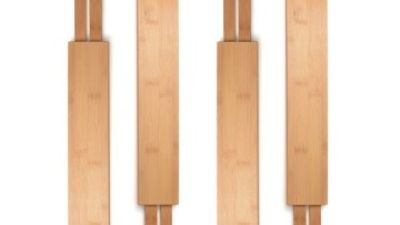
Wood drawers often become crowded because utensils, tools, and household essentials are stored together without clear boundaries. Retractable bamboo dividers offer a simple way to create flexible compartments: adjust their length to fit the drawer, then arrange items by type or frequency of use. This makes everyday objects easier to find and helps keep them from shifting into a jumble whenever the drawer opens. Before choosing a layout, measure the drawer’s interior length and height, and leave enough room for the dividers to sit securely without obstructing its movement.
The value of practical storage is reflected in the 2024 U.S. Kitchen Trends Study: 76% of surveyed renovating homeowners upgraded their cabinets, and 94% of those upgrading cabinets added at least one specialty storage feature. Although a drawer divider is a smaller change than a cabinet renovation, the same principle applies—organize space around the items people actually use. In a utensil drawer, separate cooking tools from cutlery; in a desk drawer, give stationery, chargers, and small accessories their own sections. Reposition the dividers as needs change, making better use of existing drawer space without a fixed arrangement.
It gives a pizza a flat place to rest and looks at home on a dining table. Its broad surface is easy to wipe, but it can take up more shelf space.
Choose one for moving dough toward an oven. A tapered edge and secure, comfortable handle help. Check that the handle is not awkward to store.
Check the usable surface, not only the listed diameter. A board around 30 centimeters wide may suit a medium pizza. Measure your storage space, too.
Tight, even wood grain generally resists knife marks better than softer wood. Look for a flat face, smooth edges, and joints without visible gaps. No board stays pristine forever.
Check that the cutter’s weight feels balanced on the board. A heavy cutter can slide on a thin surface. Try the pairing before ordering in bulk.
Wash it by hand, dry it promptly, and avoid soaking it. Do not put it in a dishwasher. Small details matter.
Periodic food-safe oil may help limit drying; follow the maker’s care instructions. Check the underside after use, since moisture can collect against a damp counter. I may underestimate that risk.
Ask about wood species, moisture control, finish, care instructions, and replacement availability. Verify the finish in product documentation. A large board may serve guests well, but storing many can be a real trade-off.
This guide to the 2026 top wooden pizza boards for global buyers explores how wood types, board shapes, thickness, and surface finishes affect everyday performance. It explains how features such as a comfortable handle, a stable base, and a suitable cutting surface can make a board easier to slice on, serve from, and carry. Buyers can compare round, handled, and multi-purpose styles to find options suited to home kitchens, hospitality settings, or retail collections. Pizza Boards Wood choices are considered in terms of practical design, durability, and value.
The guide also outlines key quality and food-safety points to assess, including smooth construction, suitable finishes, and consistent workmanship. It covers sourcing, customization, packaging, and how to compare product features for different buyer needs. Finally, it offers straightforward care and maintenance guidance, such as cleaning promptly, drying thoroughly, and storing boards in a ventilated place, to help preserve their appearance and extend their useful life.